Download An Introduction to Computational Fluid Dynamics: The Finite Volume Method (2nd Edition)
Ultimate book collections can be gotten if you constantly visit this web page. Find the million of books here. All categories from many sources, publishers, and writers worldwide are presented. We not only provide the book collections from within this nation. Lots of collected books are from the outsiders. Nonetheless, the objectives are same. They are supplied as a joined library by online to offer even more priceless resources to obtain the book.
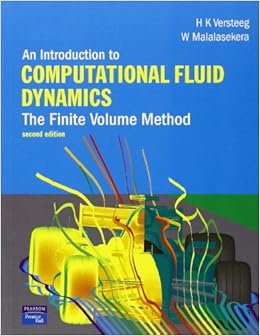
An Introduction to Computational Fluid Dynamics: The Finite Volume Method (2nd Edition)

Download An Introduction to Computational Fluid Dynamics: The Finite Volume Method (2nd Edition)
Thanks for visiting our spectacular internet site. This is a web site that could make everybody really feel so relieved. This is the one that will supply all contended book collections from the authors worldwide. Finding the book from other countries in this sit is simple, furthermore to discover guides for within the nation. That will certainly be so very easy then.
Checking out is kind of should do each day. Like exactly what you do your day-to-day tasks, eating or doing your daily tasks. And currently, why should read? Reading, again, can assist you to locate new way that will get you to life better. That's not just what you call as the responsibility. You can check out An Introduction To Computational Fluid Dynamics: The Finite Volume Method (2nd Edition) in the spare time as added tasks. It will certainly not additionally obligate you to review it for numerous pages. Just, by actions as well as you could see how this publication remarkably.
The link of the book that we offer here will certainly reveal you why you are in the very best location. It doesn't require complex features to obtain known this An Introduction To Computational Fluid Dynamics: The Finite Volume Method (2nd Edition) That's extremely straightforward. If you have the belief to lead this book, just do it. The soft data system that we provide from the gathered publications from the many nations makes you quickly to actually get guides that you search.
This suggested book entitled An Introduction To Computational Fluid Dynamics: The Finite Volume Method (2nd Edition) will certainly be able to download and install easily. After obtaining guide as your selection, you can take even more times and even couple of time to begin analysis. Page by web page may have exceptional conceptions to read it. Several factors of you will certainly enable you to review it intelligently. Yeah, by reading this publication and also finish it, you could take the lesson of what this book deal. Get it as well as dot it wisely.
From the Back Cover
The use of Computational Fluid Dynamics to simulate and predict fluid flows, heat transfer and associated phenomena continues to grow throughout many engineering disciplines. On the back of ever more powerful computers and graphical user interfaces CFD provides engineers with a reliable tool to assist in the design of industrial equipment often reducing or eliminating the need for performing trial-and-error experimentation. An Introduction to Computational Fluid Dynamics is the ideal text for the newcomer to the area whether they be undergraduates, graduates, or professionals. It provides thorough yet accessible coverage of commercial finite volume based CFD codes within the context of the underlying theory, giving the reader a full appreciation of CFD and its numerous engineering applications. Key features Offers essential support for novice users of commercial CFD codes such as ANSYS CFX, FLUENT, STAR-CD and PHOENICS. Covers fluids and turbulence physics together with computational modelling techniques Uses a step-by-step approach to introduce the methodology Chapter summaries and worked examples throughout to reinforce understanding of the key concepts New to this edition A new chapter describing unstructured meshing techniques A new chapter on CFD uncertainty New coverage of the fundamentals of Large-Eddy Simulation (LES) and Direct Numerical Simulation (DNS) techniques Summaries of TVD techniques and multi-grid solution techniques Added examples of the SIMPLE algorithm for pressure-velocity coupling Two new chapters with advanced material covering combustion and radiative heat transfer modelling H K Versteeg and W Malalasekera are both senior lecturers in Thermo-Fluids, at Loughborough University.
Read more
Product details
Paperback: 520 pages
Publisher: Pearson; 2 edition (February 16, 2007)
Language: English
ISBN-10: 0131274988
ISBN-13: 978-0131274983
Product Dimensions:
7.5 x 1.2 x 9.6 inches
Shipping Weight: 2.2 pounds (View shipping rates and policies)
Average Customer Review:
3.9 out of 5 stars
13 customer reviews
Amazon Best Sellers Rank:
#807,322 in Books (See Top 100 in Books)
This is a very readable and practical book that focuses only on incompressible semi-implicit methods. It is an introduction, it moves at a slower pace and covers less ground than the Ferziger & Peric book, but what it does address is very well explained. I own both the first and second edition. I had reviewed the first edition 10 years ago and was only moderately impressed because it was similar to Patankar's book but published 15 years later. The 2nd edition has added a lot of material which advances the topic quite a bit from the 1st edition.My main complaint about the first edition was that it focused on Cartesian structured grids which is pretty dated. The new version has a chapter on collocation of variables and how to handle the pressure gradient in the continuity correction step. Additionally it explains how to account for convection and diffusion in generalized non-Cartesian coordinates. It would be nice if storage and solution methods were explained for the iterative solver needed for an unstructured mesh but that aside the material presented in this new chapter is very well explained.Another nice touch is explanation of multigrid techniques as an iterative solver. The authors allude to implementing multigrid into the outer iterations but do not drill down on the topic.There is a chapter explaining the introduction for turbulence modeling but it is not complete enough to implement without supplemental sources.This book gives very detailed step by step explanations of many things in the first edition, detailed examples of calculations and results are shown which really illustrate the method and where the pitfalls are. There are less examples for the newer material, but it is still explained carefully. The material is very accessible. One could use this book by itself to write a very basic code based on this method. I could imagine if the authors were to make a third edition where turbulence, multigrid and unstructured solution techniques were addressed with the same depth as some of the other topics that the book could become a real institution.
An excellent book for anyone starting into Finite Volume method. An noticeable improvement in comparison with the last edition, by including examples that helps the reader to understand how to apply its techniques.
Well written, I had an easier time learning from reading this book than I did from lectures.
It's a great book with which can understand how they work using the method of finite volumes as softwares CFX and FLUENT, gives you an excellent vision for beginners in the field of computational fluid dynamics.
Versteeg & Malalasekera's "An Introduction to CFD: The FVM" has been my first contact to CFD. I really recommend this book as a first approach. It provides easy and enjoyable reading. I still read it and follow its exercises.
it is great with information, examples, chapter orgnizing. i used it in my exams and got good scores. it helped a lot.
The book is exactly what I expected. Lots of details, can be used to write your own CFD code. Good transaction.
Great book, if you are starting in the field of CFD, I would recomend it to have more practical examples.
An Introduction to Computational Fluid Dynamics: The Finite Volume Method (2nd Edition) PDF
An Introduction to Computational Fluid Dynamics: The Finite Volume Method (2nd Edition) EPub
An Introduction to Computational Fluid Dynamics: The Finite Volume Method (2nd Edition) Doc
An Introduction to Computational Fluid Dynamics: The Finite Volume Method (2nd Edition) iBooks
An Introduction to Computational Fluid Dynamics: The Finite Volume Method (2nd Edition) rtf
An Introduction to Computational Fluid Dynamics: The Finite Volume Method (2nd Edition) Mobipocket
An Introduction to Computational Fluid Dynamics: The Finite Volume Method (2nd Edition) Kindle

Tidak ada komentar :
Posting Komentar