Free Ebook How to Write a Sentence: And How to Read One
So, when you actually don't want to run out of this publication, follow this internet site as well as obtain the soft data of this book in the web link that is provided here. It will lead you to straight obtain guide without awaiting lot of times. It simply has to link to your internet and get just what you should do. Naturally, downloading and install the soft documents of this book can be achieved effectively and also conveniently.
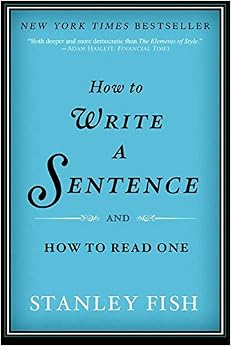
How to Write a Sentence: And How to Read One

Free Ebook How to Write a Sentence: And How to Read One
After waiting on some minutes, finally we could offer How To Write A Sentence: And How To Read One in this web site. This is just one of the books that mainly most waited and also wanted. Spending even more times to wait for this book will certainly not be issue. You will certainly also discover the proper way to verify the amount of people talk about this publication. After the introducing, this book can be found in lots of resources.
As one of the book compilations to propose, this How To Write A Sentence: And How To Read One has some solid factors for you to read. This publication is really ideal with what you need now. Besides, you will additionally enjoy this publication How To Write A Sentence: And How To Read One to review considering that this is one of your referred books to check out. When going to get something new based upon experience, entertainment, as well as other lesson, you could use this book How To Write A Sentence: And How To Read One as the bridge. Starting to have reading behavior can be undertaken from various methods and from variant kinds of publications
Do not underestimate; the books that we gather them are not only from within this nation. You can also discover guides from outside of the nation. They are all also different with various other. Some links are given to reveal you where to find as well as get it. This How To Write A Sentence: And How To Read One as one of the examples can be obtained conveniently. And why you must advise this book for yourselves and your close friends is that this publication holds crucial duty to improve your life high quality as well as quantity.
Stray at home or office, you can take it quickly. Simply by connecting to the net as well as obtain the link to download, you expectation to get this book is recognized. This is what makes you feel satisfied to get over the How To Write A Sentence: And How To Read One to read. This readable publication has very easy languages for reading by all people. So, you might not need to really feel clinically depressed to locate guide as good for you. Just determine your time to acquire guide as well as find the suggestion for a few other publications right here.
Review
“Both deeper and more democratic than The Elements of Style.” (Financial Times)“A guided tour through some of the most beautiful, arresting sentences in the English language.” (Slate)“[Fish] shares his connoisseurship of the elegant sentence.” (The New Yorker)“Stanley Fish just might be America’s most famous professor.” (BookPage)“How to Write a Sentence is a compendium of syntactic gems—light reading for geeks.” (New York magazine)“How to Write a Sentence isn’t merely a prescriptive guide to the craft of writing but a rich and layered exploration of language as an evolving cultural organism. It belongs not on the shelf of your home library but in your brain’s most deep-seated amphibian sensemaking underbelly.” (Maria Popova, Brain Pickings)“[Fish’s] approach is genially experiential—a lifelong reader’s engagement whose amatory enthusiasm is an attempt to overthrow Strunk & White’s infamous insistences on grammar by rote.” (New York Observer)“In this small feast of a book Stanley Fish displays his love of the English sentence. His connoisseurship is broad and deep, his examples are often breathtaking, and his analyses of how the masterpieces achieve their effects are acute and compelling.” (New Republic)“A sentence is, in John Donne’s words, ‘a little world made cunningly,’ writes Fish. He’ll teach you the art.” (People)“This splendid little volume describes how the shape of a sentence controls its meaning.” (Boston Globe)
Read more
From the Back Cover
Some appreciate fine art; others appreciate fine wines. Stanley Fish appreciates fine sentences. The New York Times columnist and world-class professor has long been an aficionado of language. Like a seasoned sportscaster, Fish marvels at the adeptness of finely crafted sentences and breaks them down into digestible morsels, giving readers an instant play-by-play. In this entertaining and erudite gem, Fish offers both sentence craft and sentence pleasure, skills invaluable to any writer (or reader). How to Write a Sentence is both a spirited love letter to the written word and a key to understanding how great writing works; it is a book that will stand the test of time.
Read more
See all Editorial Reviews
Product details
Paperback: 176 pages
Publisher: Harper Paperbacks; Reprint edition (August 7, 2012)
Language: English
ISBN-10: 006184053X
ISBN-13: 978-0061840531
Product Dimensions:
5.3 x 0.4 x 8 inches
Shipping Weight: 8 ounces (View shipping rates and policies)
Average Customer Review:
3.8 out of 5 stars
130 customer reviews
Amazon Best Sellers Rank:
#31,315 in Books (See Top 100 in Books)
How to write a sentence. Sounds simple enough, doesn't it? There, I've just written two. In the second, I omitted the subject which should probably be "It"; that is, "It sounds simple . . . ." This "It" standing for "How to write a sentence," the second "it" standing in for "sound simple."As a native English speaker, I can crank out sentences and analyses like these all day long. Why would I want to read Stanley Fish's thin book, How to Write a Sentence and How to Read One?Because he will make me—and you—think about sentences, which are, after all, basic to the writer's trade. For example, what is a sentence? Fish points out that writing guides offer answers: "A sentence is a complete thought." "A sentence contains a subject or a predicate." "Sentences consist of one or more clauses that bear certain relationships to one another." He says that "far from being transparent and inclusive, these declarations come wrapped in a fog; they seem to skate on their own surface and simply don't go deep enough."Okay, professor, what does go deeper? "Well, my bottom line can be summarized in two statements: (1) a sentence is an organization of items in the world; and (2) a sentence is a structure of logical relationships." A random list of items, for example, is not a sentence. He quotes Anthony Burgess: "And the words slide into the slots ordained by syntax, and glitter as with atmospheric dust with those impurities which we call meaning." In Fish's formula, "Sentence craft equals sentence comprehension equals sentence appreciation."He discusses sentence form and how to turn a list of words into a sentence, using the Noam Chomsky example: "furiously sleep ideas green colorless" which can be turned into something meaningful (or more meaningful) as "colorless green ideas sleep furiously," which could be a line of poetry. The question one has to ask oneself when writing a sentence is "What am I trying to do?""It is often said," he writes, "that the job of language is to report or reflect or mirror reality, but the power of language is greater and more dangerous than that; it shapes reality, not of course in the literal sense—the world is one thing, words another—but in the sense that the order imposed on a piece of the world by a sentence is only one among innumerable possible orders." And every time you revise a sentence, add a modifier, delete a clause, change a tense you've changed that "reality."Once Fish has discussed sentences generally, he spends three chapters describing the subordinating style, the additive style, and the satiric style of sentences with examples. Here is a sample of the satiric style. J. L. Austin cautioning readers not to be impatient with the slow unfolding of his argument: "And we must at all costs avoid over-simplification, which one might be tempted to call the occupational disease of philosophers if it were not their occupation."With practical suggestions of how to form an infinite number of sentences using a relatively few forms, Fish offers chapters on first sentences—"One day Karen DeCilia put a few observations together and realized her husband Frank was sleeping with a real estate woman in Boca" (Elmore Leonard)—and last—"He was soon borne away by the waves and lost in darkness and distance" (Mary Shelley). Wonderful stuff for any writer who is struggling to start a piece or finish one.The last chapter, "Sentences That Are About Themselves (Aren't They All?)" summarizes and extends the discussion to works like Ford Maddox Ford's The Good Soldier in which the narrator in telling one story is, as the reader comes to realize, unconsciously telling another story entirely.Every serious writer should keep How to Write a Sentence on the bookshelf to take down every year or so and read once again.
Author Annie Dillard ("The Writing Life," 1989) was asked by a student, "Do you think I could be a writer?" Dillard's response: "Do you like sentences?" According to Stanley Fish, author of "How to Write a Sentence," it's as important for writers to genuinely like sentences as it is for great painters to like paint. For those who enjoy an effective sentence and all that it involves, this short (160 page) book is insightful, interesting and entertaining. For those who consider reading or writing a chore, perhaps this book can help one's interest level and motivation regarding sentences, though the author's intended audience is clearly those with a genuine interest in writing.Fish would seem to be well qualified to write, having taught at the University of California at Berkeley, Johns Hopkins University, Duke University, and the University of Illinois at Chicago. However, as any student who has suffered with a highly qualified--yet thoroughly boring--professor knows, a significant part of the education/communication process involves instilling motivation. That's where Fish shines. If it might seem that a whole book on sentences has to be boring, Stanley Fish quickly overcomes this perception. His book is divided into 10 chapters: (1) Why Sentences?; (2) Why You Won't Find the Answer in Strunk and White [Strunk and White authored the classic, "The Elements of Style"]; (3) It's Not the Thought That Counts [nothing like a little provocation to get us interested]; (4) What Is a Good Sentence?; (5) The Subordinating Style; (6) The Additive Style; (7) The Satiric Style: The Return of Content; (8) First Sentences; (9) Last Sentences; and (10) Sentences That Are About Themselves (Aren't They All?).Author Fish includes many examples of powerful sentences from a very wide range of writers, such as Herman Melville, Edgar Allan Poe, Cicero, Lewis Carroll, Michel de Montaigne, Agatha Christie, Charles Dickens and others. Here's one illustrative example from John Updike: Describing the home run Ted Williams hit at his last at-bat in Boston's Fenway Park on September 28, 1960, Updike wrote, "It was in the books while it was still in the sky." Think about that for a minute.In conclusion, Stanley Fish is an enthusiastic writer, and he manages to convey and transmit his enthusiasm for writing clear, effective sentences in this highly readable book. If you are interested in writing (and reading), this book is worth your careful consideration.UPDATE on January 29, 2011: I wrote the above from the viewpoint of the reader contemplating buying this book for his or her own use. As I think more about the book, however, there's another possibility worth exploring. Specifically, this book could make a fine graduation (or other) gift to a niece, nephew or friend's child. First, it's short and easy to read, which means it might actually get read. Second, good writing is important in any profession. Third, the book helps reinforce the point that if you want to get good at something, it pays to study experts in the field. Fourth, and perhaps most important, the book supports the point that success in writing--as in virtually all endeavors--comes from practice, practice, practice. That's a pretty useful message to send any student.
If not for anything else, Stanley Fish's "How to Write a Sentence: And How to Read One" made me understand why I love the authors I love so much. It put me back in touch with Pater, Stein, Woolf, Hemingway, and so many other writers that I devoured back in college and in graduate school. Normally, I dislike having the works I love dissected, deconstructed, whatever, because it is done so, usually, to meet some political agenda. In the case of Fish's work, it is done so for the reader's appreciation of the text and an appreciation of the writer's labor. What follows after all this appreciation, it is hoped, will be an ability for anyone interested in writing to do so with command, style and clarity. (However, I must admit that I am extremely self-conscious of my writing right now.)As an instructor of freshman English composition, however, I am reluctant to pooh-pooh Strunk & White's "The Elements of Style". While I understand Fish's complaint about its use (or over-use), I cannot dismiss "The Elements of Style" so quickly. Too many students have found it valuable. I am, however, considering using "How to Write a Sentence..." for my more advanced classes and elective writing courses.One last note, I got the hardcover, in nearly perfect condition, for under $10. Maybe I should write something called "How to Buy a Book."Maybe not.Rocco DormarunnoThe College of New Rochelle
How to Write a Sentence: And How to Read One PDF
How to Write a Sentence: And How to Read One EPub
How to Write a Sentence: And How to Read One Doc
How to Write a Sentence: And How to Read One iBooks
How to Write a Sentence: And How to Read One rtf
How to Write a Sentence: And How to Read One Mobipocket
How to Write a Sentence: And How to Read One Kindle

Tidak ada komentar :
Posting Komentar